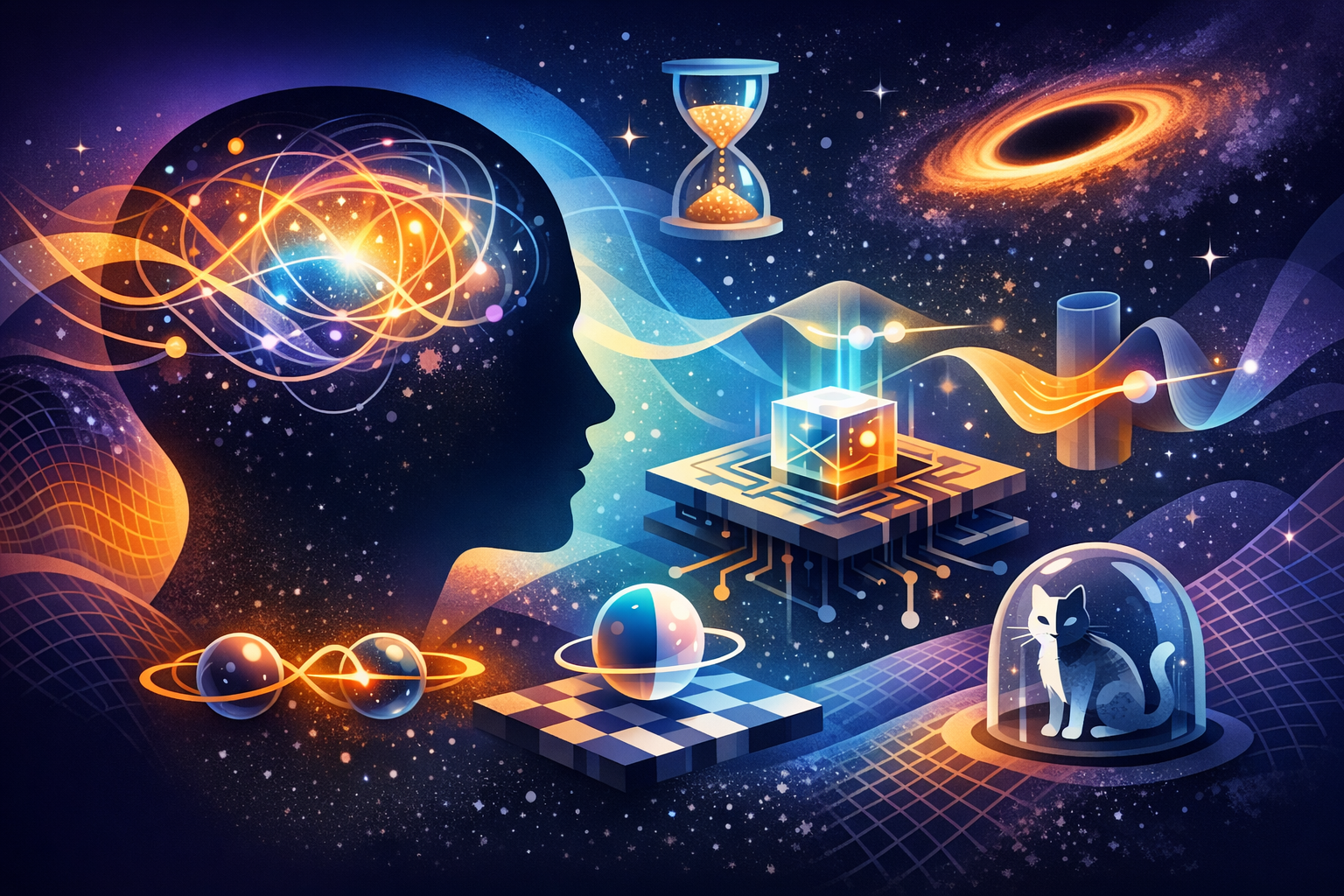
The Quantum Leap: From Classical to Quantum
Quantum computing stands on the precipice of technology, ready to redefine what's possible. Unlike classical computing, which relies on bits as a binary system of 0s and 1s, quantum computing utilizes qubits. These qubits can exist in multiple states at once, thanks to the mind-boggling principle of superposition. But what does this mean for the future of technology?
Superposition: The Multi-Dimensional Potential
In the classical world, a bit is like a coin that can either be heads or tails. A qubit, however, is more like a spinning coin—holding the potential for both heads and tails simultaneously. Superposition allows quantum computers to process vast amounts of data at unprecedented speeds, solving complex problems that today’s supercomputers can only dream of.
Entanglement: The Quantum Connection
Entanglement is another core concept that challenges our traditional understanding of physics. When qubits become entangled, the state of one qubit is directly related to the state of another, no matter the distance between them. Einstein famously referred to this as "spooky action at a distance." This interconnectivity opens up revolutionary possibilities for teleportation of information and ultra-secure communication networks.
Quantum Tunneling: Breaking Through Barriers
Quantum tunneling allows particles to pass through barriers, defying logical constraints. In computing, this phenomenon can speed up processes that classical computers find insurmountable. Quantum algorithms, such as Shor's algorithm for factoring large numbers, exploit these principles to potentially crack encryption that secures our digital world today.
The Uncertainty Principle: Embracing Ambiguity
Heisenberg’s Uncertainty Principle posits that certain pairs of physical properties, like position and momentum, cannot both be known to arbitrary precision. In quantum computing, this translates into a probabilistic approach to problem-solving, offering solutions that are optimal but not exact. This may seem paradoxical, but it’s this very uncertainty that can yield powerful computational efficiencies.
Quantum Supremacy: The Dawn of a New Era
Quantum supremacy marks the moment when quantum computers outperform classical ones. In 2019, Google claimed to have achieved this milestone. The implications are enormous, potentially transforming fields like cryptography, drug discovery, and artificial intelligence. However, with great power comes the challenge of harnessing it safely and ethically.
The Challenges Ahead
While the potential of quantum computing is vast, several hurdles remain. Qubits are notoriously unstable, susceptible to decoherence, which causes them to lose their quantum state. Technical advancements in error correction and qubit stabilization are crucial. Moreover, integrating quantum with classical systems poses its own share of challenges.
The Future: Not If, But When
The road to quantum computing dominance is fraught with technical and ethical challenges. However, the promise of solving problems previously considered intractable makes it an irresistible frontier. As research accelerates, the question isn't if quantum computing will revolutionize technology, but when and how it will reshape our world.