The Mysterious Menagerie of Ancient Maps
Ancient maps, those parchment treasures of historical navigation, often reveal a world teeming with mythical creatures. From dragons to sea serpents, these fantastical beasts were not just artistic embellishments but reflected the worldview and anxieties of the times. But what drove mapmakers to populate their charts with such monstrous beings?
The Role of Monsters in Medieval Cartography
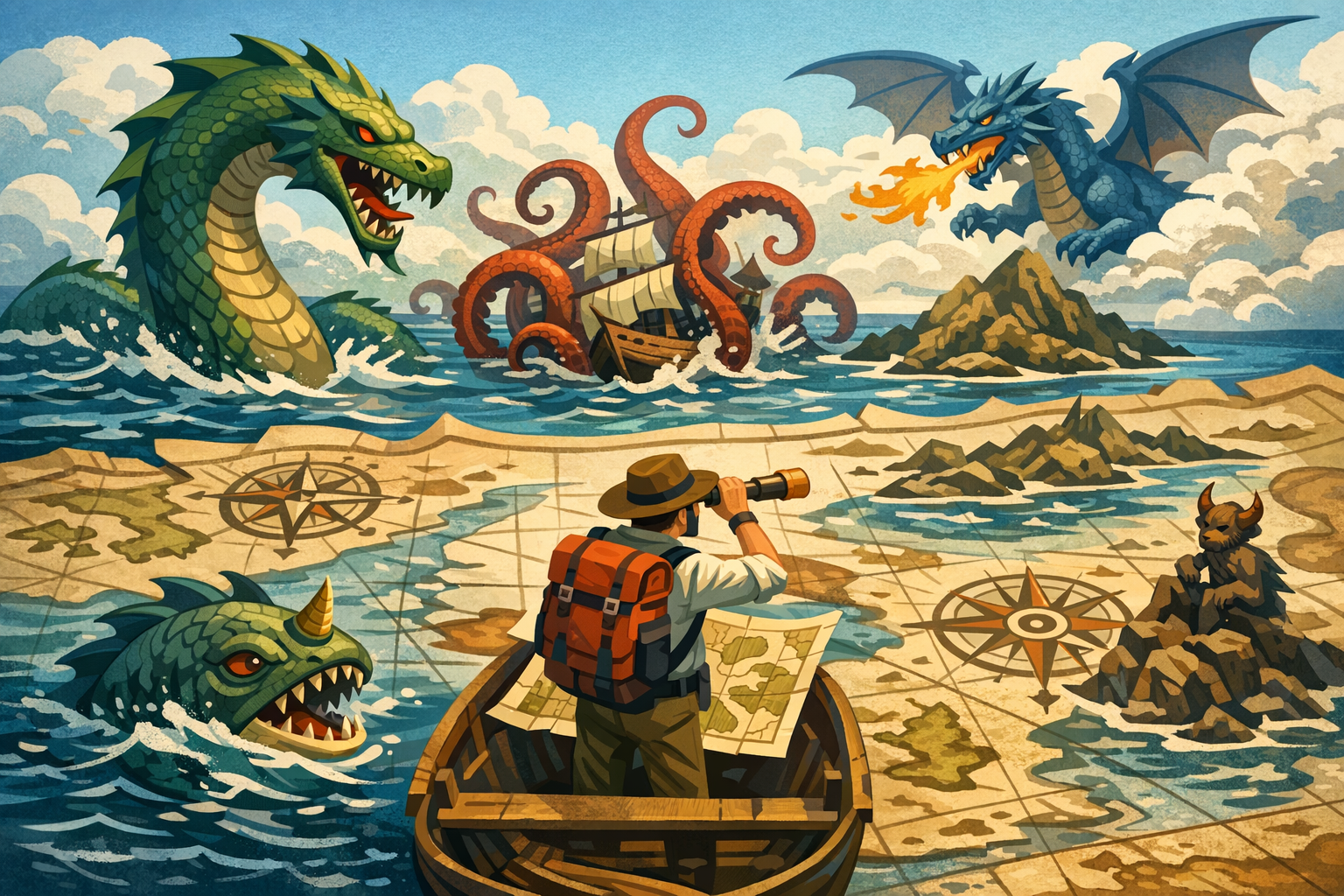
During the Middle Ages, maps served as more than geographical guides; they were also narrative tools. The inclusion of monsters often symbolized the unknown, a stark reminder of unexplored territories. These creatures acted as cognitive boundary markers, warning mariners of uncharted and potentially perilous waters beyond the known world.
Reflecting Fear and Ignorance
The oceans, vast and mysterious, were both highways and barriers. For sailors without modern navigation tools, the deep blue was filled with potential danger. The depiction of sea monsters wasn’t just an artistic choice but a manifestation of the fears borne out of ignorance and the unpredictable nature of sea voyages.
Monsters symbolized the perils that lurked in uncharted waters. They served as a mnemonic device for sailors, reminding them of past voyages where ships might have vanished or returned with tales of terrible beasts.
Mythology Meets Cartography
Many of these mythical creatures had roots in classical mythology. The Kraken, for instance, likely originated from giant squid sightings, while Leviathan and other sea monsters drew from Biblical lore. These legends found their way into maps, casting a shadow of myth over regions yet to be explored.
- Sea Serpents: Often illustrated twisting around ships, these creatures embodied the chaos and unpredictability of the sea. - Dragons and Wyverns: More common on land maps, signifying danger and areas unexplored by humans. - Leviathan: A Biblical beast, warning of God’s wrath and the ocean’s dangers.
Political Propaganda and Exoticism
Monsters also served a political purpose. By illustrating foreign lands as realms of beasts and barbarians, European mapmakers justified colonial ambitions. These depictions exaggerated the exotic and dangerous nature of distant territories, portraying them as wild lands in need of taming by European civilization.
Monsters: From Maps to Modern Media
The legacy of these monstrous maps endures today. Modern fantasy media, from literature to film, often borrow from these early cartographic myths. The monsters of old have become archetypes in our storytelling, reminding us of humanity's timeless fascination with the unknown.
Furthermore, the study of these maps provides insight into how societies viewed their world, using monsters as both cautionary symbols and as an acknowledgment of the mysteries that lay beyond their horizon.
The Shift to Scientific Cartography
With the advent of the Age of Enlightenment, scientific advancements began to reshape the purpose and design of maps. As exploration increased and the world became more known, the fantastical elements slowly faded. Maps became tools of precision rather than imagination, reflecting empirical knowledge rather than mythological speculation.
Today, we see maps as objective representations of our world, but it is crucial to remember their roots. The monsters that once roamed these charts remind us of a time when the world was vast and mysterious, filled with places left to discover and stories left untold.
In conclusion, ancient maps serve as windows into the psyche of their creators and users. By studying these maps, we can trace the journey from a world defined by myth and mystery to one shaped by exploration and understanding. The monsters may have vanished from our charts, but they continue to haunt our imaginations, a testament to the enduring human spirit of curiosity and adventure.