The Grand Cosmic Ballet: Galaxy Collisions
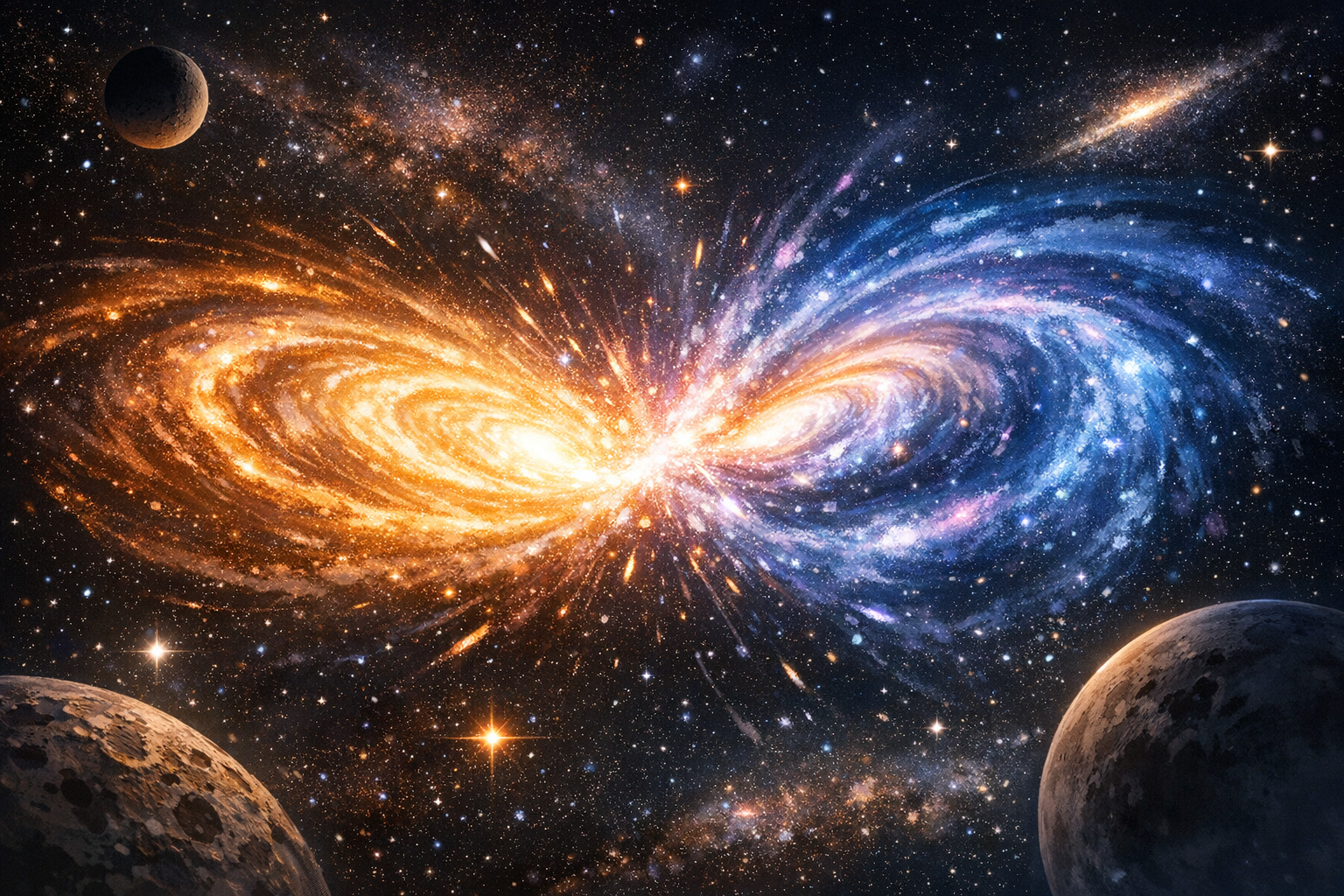
In the vast arena of the universe, galaxies perform a bewildering dance. These colossal structures, teeming with stars, dust, and dark matter, occasionally engage in a spectacular cosmic ballet – a galaxy collision. Although the term 'collision' suggests a catastrophic event, these interactions are more like a slow, majestic waltz, spanning millions of years. When galaxies collide, they reshape, merge, and sometimes birth entirely new galaxies, challenging our understanding of cosmic evolution.
The Science Behind Collisions
Galaxies are not static, solitary entities. They reside in a universe constantly expanding, with gravitational forces pulling them towards one another. This attraction can lead to collisions, especially in densely populated galaxy clusters. Despite the seemingly violent nature, individual stars within these galaxies rarely collide due to the vast distances between them. Instead, the gravitational forces exerted cause dramatic shifts in structure and star formation.
The Anatomy of a Collision
The process unfolds in stages: initial approach, interaction, merger, and final relaxation. During the initial approach, galaxies draw near, tugging at each other's structures. This stage can trigger intense star formation as gases compress, igniting new stellar nurseries. As they begin to interact, tidal forces stretch and distort galaxies into intricate shapes, forming long, bright tails of stars and gas.
Eventually, as the galaxies merge, their cores coalesce into a single, often more massive galaxy. This merging process can take a billion years or more, resulting in a chaotic blend of stars, gas, and dark matter. The final stage sees the galaxy settle into a new, stable form, often an elliptical galaxy with little ongoing star formation.
Cosmic Curiosities: Notable Collisions
- The Antennae Galaxies: Located about 45 million light-years away, these are a prime example of interacting galaxies caught in the throes of collision. Their name comes from the long, antenna-like structures formed by these interactions. - The Milky Way and Andromeda: Our own galaxy is on a collision course with the Andromeda galaxy. Predicted to occur in about 4 billion years, this titanic event will reshape both galaxies into a new, possibly elliptical form. - The Cartwheel Galaxy: This galaxy's distinctive ring shape is the result of a smaller galaxy passing through its center, triggering a massive wave of star formation.
Challenges and Cosmic Mysteries
Despite significant advancements in technology and simulations, galaxy collisions remain a fertile ground for scientific inquiry. Understanding these interactions could provide insights into the behavior of dark matter, which plays a crucial role in galaxy dynamics. Furthermore, they offer clues about the universe's history and future evolution.
The dynamics of these collisions also challenge our grasp of fundamental physical laws. For instance, the distribution of mass and energy during a collision can reveal discrepancies in our understanding of gravity at galactic scales, possibly hinting at new physics beyond the current models.
Conclusion: A Cosmic Puzzle
Galaxy collisions are more than just dramatic cosmic events; they are essential processes in the universe's life cycle. Each collision offers a snapshot of evolution, destruction, and creation, weaving a complex narrative of cosmic history. As astronomers continue to study these enigmatic interactions, we edge closer to unraveling the universe's grandest mysteries, one collision at a time.