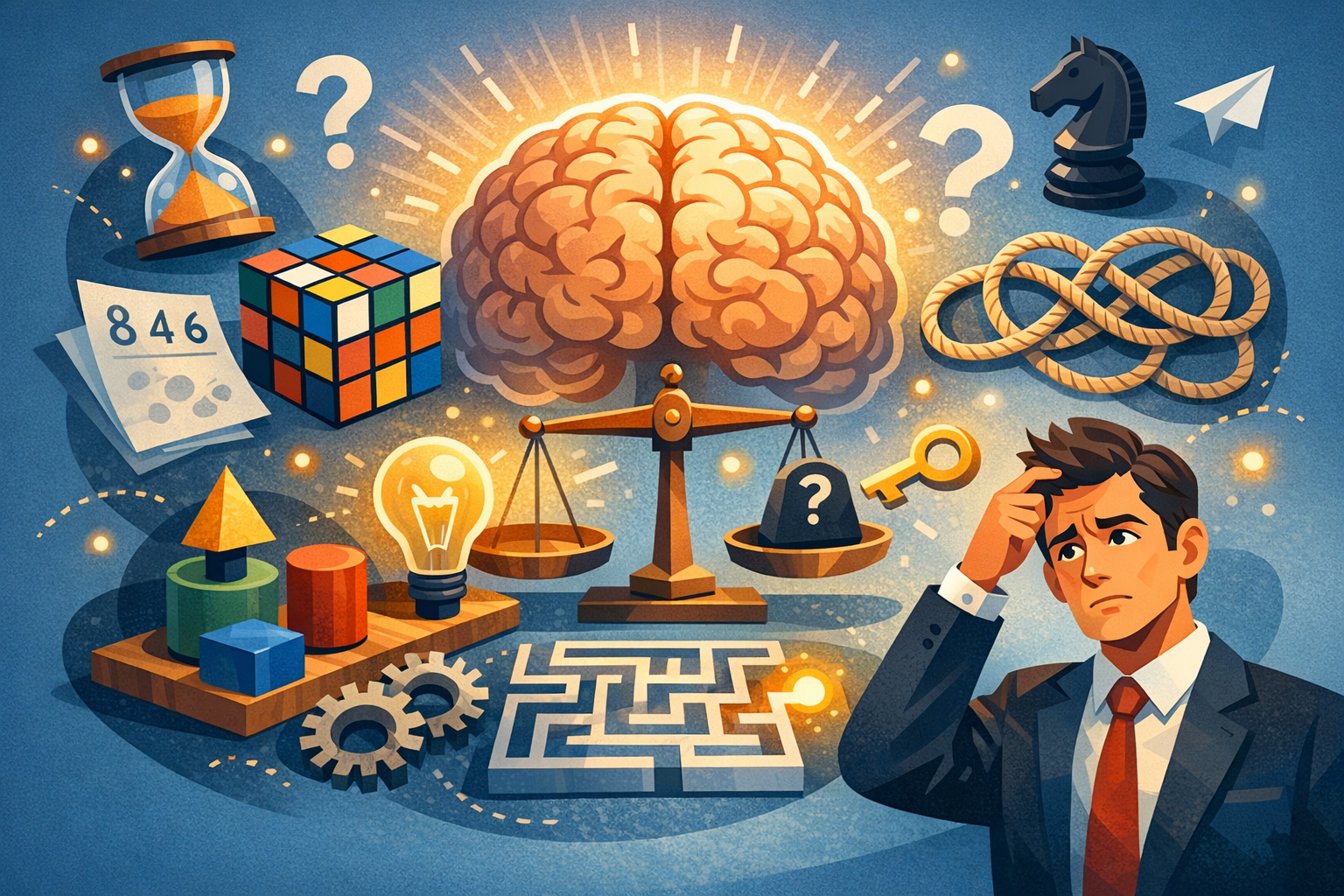
Throughout history, even the most brilliant minds have encountered puzzles that left them scratching their heads. These brain teasers do more than entertain—they challenge our understanding of logic, mathematics, and human ingenuity. Let's explore some historical puzzles that have perplexed even the smartest thinkers, revealing solutions that are both surprising and enlightening.
The Monty Hall Problem: A Game Show Conundrum
First introduced on the game show Let’s Make a Deal, the Monty Hall Problem has baffled mathematicians for decades. The scenario is simple: a contestant is asked to choose one of three doors, behind one of which is a car; the other two hide goats. After selecting a door, the host, Monty Hall, who knows what's behind the doors, opens one of the remaining two doors, revealing a goat. The contestant then has the option to stick with their original choice or switch to the other unopened door.
Initially, intuition suggests a 50/50 chance of winning by switching. However, mathematics tells us otherwise: switching the choice actually increases the probability of winning the car to 2/3, while sticking with the initial choice keeps it at 1/3. This counterintuitive result has been a topic of debate among mathematicians, proving that sometimes, logic defies common sense.
The Seven Bridges of Königsberg: A Eulerian Challenge
In the 18th century, the city of Königsberg in Prussia posed a problem that seemed simple but was deeply complex. The city was set on two islands connected by seven bridges. The challenge was to devise a walk through the city that would cross each bridge once and only once.
Leonhard Euler, a Swiss mathematician, tackled this problem by laying the foundations for graph theory. He demonstrated that no such path existed due to the configuration of the land and bridges. This realization led to the creation of Euler's theorem, which states that for such a path to exist, each vertex (representing land masses) must have an even degree of bridges.
Zeno's Paradoxes: Infinity in Motion
In ancient Greece, philosopher Zeno of Elea introduced a set of paradoxes designed to challenge our understanding of motion and infinity. One famous paradox involves a race between swift-footed Achilles and a tortoise. If the tortoise is given a head start, Zeno argues that Achilles can never catch the tortoise because he must first reach the point where the tortoise has been, by which time the tortoise will have moved a little further.
Zeno's paradoxes were intended to show that our understanding of space, time, and motion was inherently flawed. It took over two millennia for calculus, developed by Newton and Leibniz, to offer a solution by introducing the concept of convergent series, where infinite sums can indeed converge to finite values.
The Poincaré Conjecture: Topology's Tough Nut
Proposed by French mathematician Henri Poincaré in 1904, this conjecture remained unsolved for nearly a century. It challenges our understanding of three-dimensional spaces, essentially stating that any shape without holes that is enclosed entirely by a surface can be deformed into a sphere.
Its resolution required the brilliance of Russian mathematician Grigori Perelman, who in 2003 proposed a proof using Ricci flow with surgery, a complex concept in differential geometry. His solution not only solved the conjecture but also earned him a Fields Medal, which he famously declined, shunning the limelight to focus on mathematics in solitude.
Conclusion: The Unending Quest for Knowledge
The brain teasers that have stumped geniuses throughout history remind us of the infinite complexity of the world and the boundless nature of human curiosity. These puzzles not only test our intellectual limits but also drive advancements in mathematical theory and logical reasoning. As we continue to encounter new challenges, the lessons from these historical conundrums inspire us to think beyond the obvious, embrace curiosity, and celebrate the pursuit of understanding.