Introduction
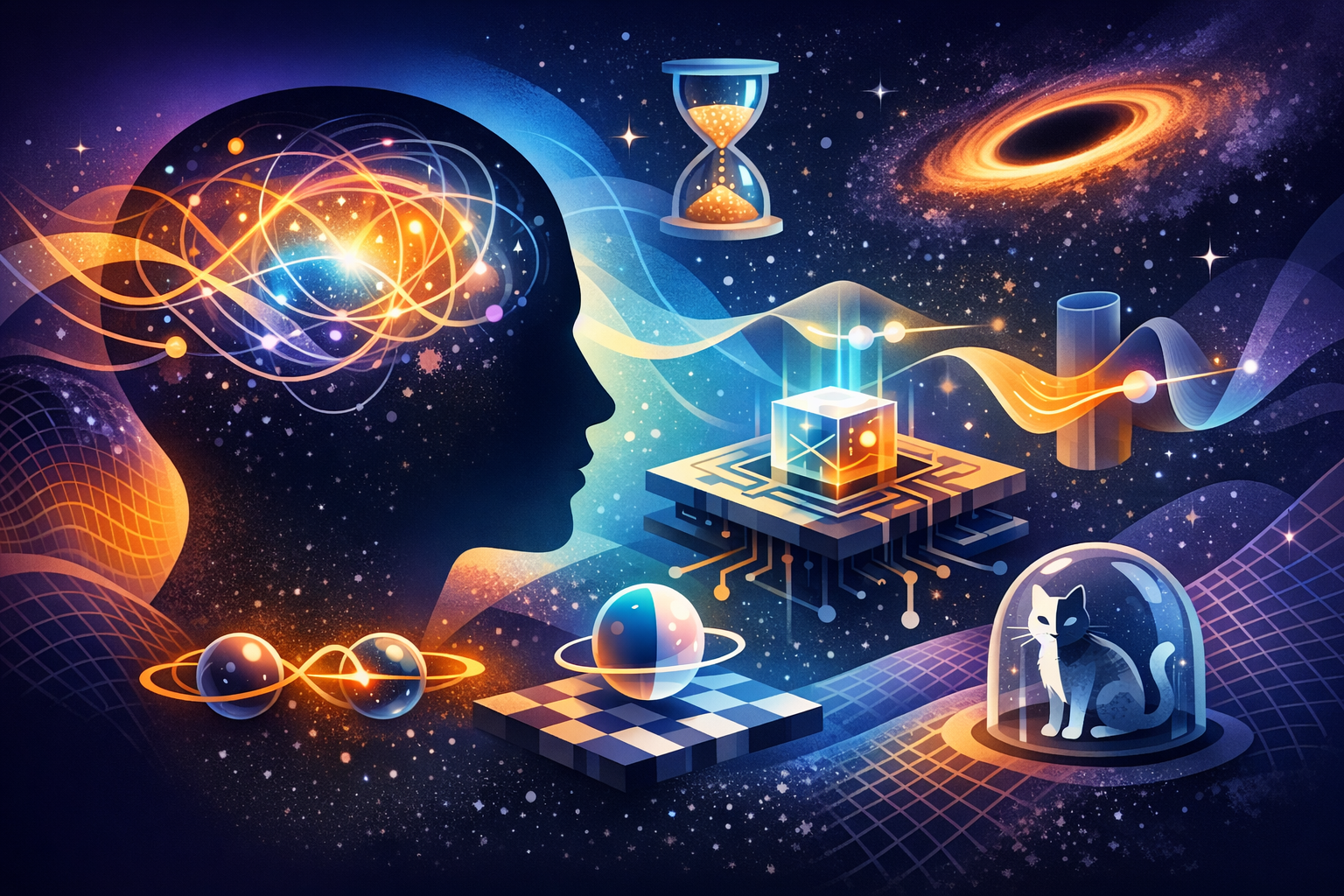
Time travel has long captured the imagination of scientists, writers, and dreamers. While the idea of leaping back and forth through time seems firmly rooted in the realm of science fiction, recent advancements in theoretical physics and experimental setups have brought us closer to the concept of time travel than ever before. Let's explore how time travel is becoming a temporary reality through groundbreaking scientific experiments.
Theoretical Foundations
Einstein’s Relativity at Play
At the heart of time travel discussions lies Einstein’s theory of relativity, which fundamentally changed our understanding of time and space. According to relativity, time is not a constant but a variable influenced by speed and gravity. This malleability of time lays the groundwork for the concept of time travel. Specifically, if one could travel at speeds approaching the speed of light, time for them would pass differently than for stationary observers. This time dilation effect has been observed with atomic clocks on high-speed jets, hinting at the possibility of moving through time.
Quantum Entanglement and Time Loops
Quantum mechanics introduces even more tantalizing possibilities. Quantum entanglement suggests that particles can be instantaneously connected across vast distances, a phenomenon that baffled even Einstein. Some physicists propose that this instantaneous connection could be a form of time travel, as information seems to traverse the divide instantly. Moreover, time loops, also known as closed timelike curves, are theoretical constructs where time returns to its starting point, allowing for potential backward time travel.
Experimental Advances
Simulating Time Reversal
In laboratories around the globe, physicists are conducting experiments that mimic aspects of time travel. One notable experiment involved reversing the state of a quantum computer, essentially creating a 'time reversal' of its state. This process doesn't allow for backward time travel in the traditional sense but hints at the reversible nature of quantum systems, a crucial aspect of potential time manipulation.
Gravity and Time Dilation
The effects of gravity on time have also been tested more accurately using ultra-precise atomic clocks placed at varying altitudes on Earth. These experiments confirm that clocks at higher altitudes tick slightly faster than those at lower altitudes, due to weaker gravitational forces. This supports the notion that manipulating gravity could, in theory, allow for time travel by altering time flow.
Bizarre Implications and Challenges
Paradoxes and Causality
If time travel were possible, it could introduce paradoxes, such as the famous grandfather paradox—traveling back in time to prevent one's own existence. These paradoxes challenge our understanding of causality and the linear nature of time. Some theories suggest that multiple timelines could exist, side-stepping these paradoxes, but this remains speculative.
Ethical and Philosophical Questions
The implications of time travel extend beyond physics into ethical and philosophical realms. If time travel were achievable, who would have access to it? Would altering past events create ethical dilemmas, such as changing historical outcomes or altering personal history? These questions require careful consideration as we edge closer to making time travel a reality.
Conclusion
While we are yet to build a time machine capable of sending us to the past or future, the scientific experiments underway offer a glimpse into a future where time travel could be more than just a fantasy. These experiments not only test the limits of our current understanding of physics but also challenge us to rethink the very nature of reality. As research continues, we stand on the cusp of a new era where time travel may no longer be just the stuff of dreams.